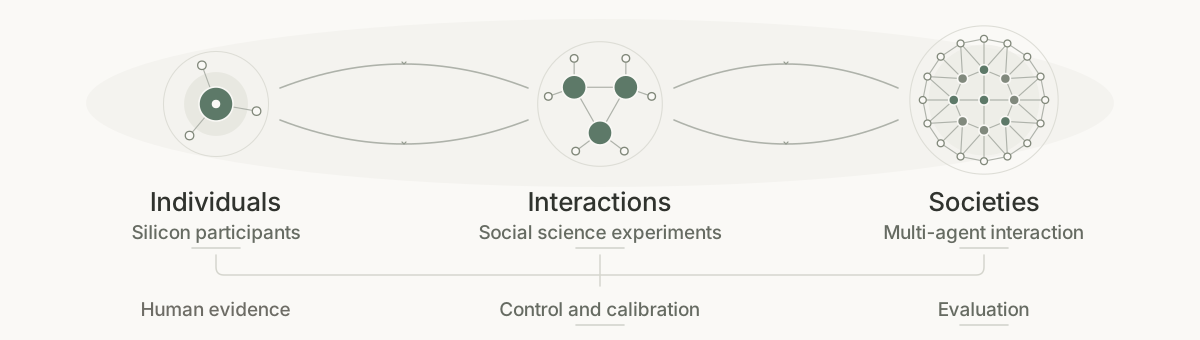
Individuals, interactions, and societies influence each other; evidence, calibration, and evaluation matter at every scale. Tags are reading entry points and can span several scales. The map offers an orientation to the field, informed by the readings below.
From Individual to SocietyMou et al. · 2024 · A survey across individual, scenario, and society-level simulation.
Chance Jiajie Li*, Zhenze Mo*, Yuhan Tang*, Ao Qu, Jiayi Wu, Kaiya Ivy Zhao, Yulu Gan, Jie Fan, Jiangbo Yu, Hang Jiang, Paul Pu Liang, Jinhua Zhao, Luis Alberto Alonso Pastor, Kent Larson
* Equal contribution.
Accepted to EMNLP 2026 Main. Earlier presentations: NeurIPS 2025 workshops — PersonaLLM (Oral) and LAW (Spotlight). Publication history ↗
Benchmarks whether models can recover a person’s beliefs and predict belief updates under intervention, using questionnaires and think-aloud interviews across three policy domains.
Benchmarks whether models can recover a person’s beliefs and predict belief updates under intervention, using questionnaires and think-aloud interviews across three policy domains.
Silicon participants
Tests individual-level reasoning simulation using human participants’ self-reported beliefs and reasoning traces, rather than population-level averages.
Maintained by Social Atoms. Each paper is selected for its contribution to simulating human behavior, social interaction, or collective dynamics.
What belongs in the list?+
Original research and benchmarks on social simulation are published or verifiably accepted at leading conferences and journals. Selected position papers and surveys have a separate topic.
Years refer to the publication or acceptance venue. Papers in each topic are ordered from newest year to oldest. Topic labels describe a paper’s focus; they are not ratings of evidence or reliability.
How can I contribute?+
Suggest a paper with its official publication link, venue, and a short explanation of its social-simulation contribution. Use the existing topics and prioritize the paper’s main contribution.